30 9 月, 2026
Sports Nasal Strips: How They Work, Materials, Benefits & OEM Manufacturing Guide
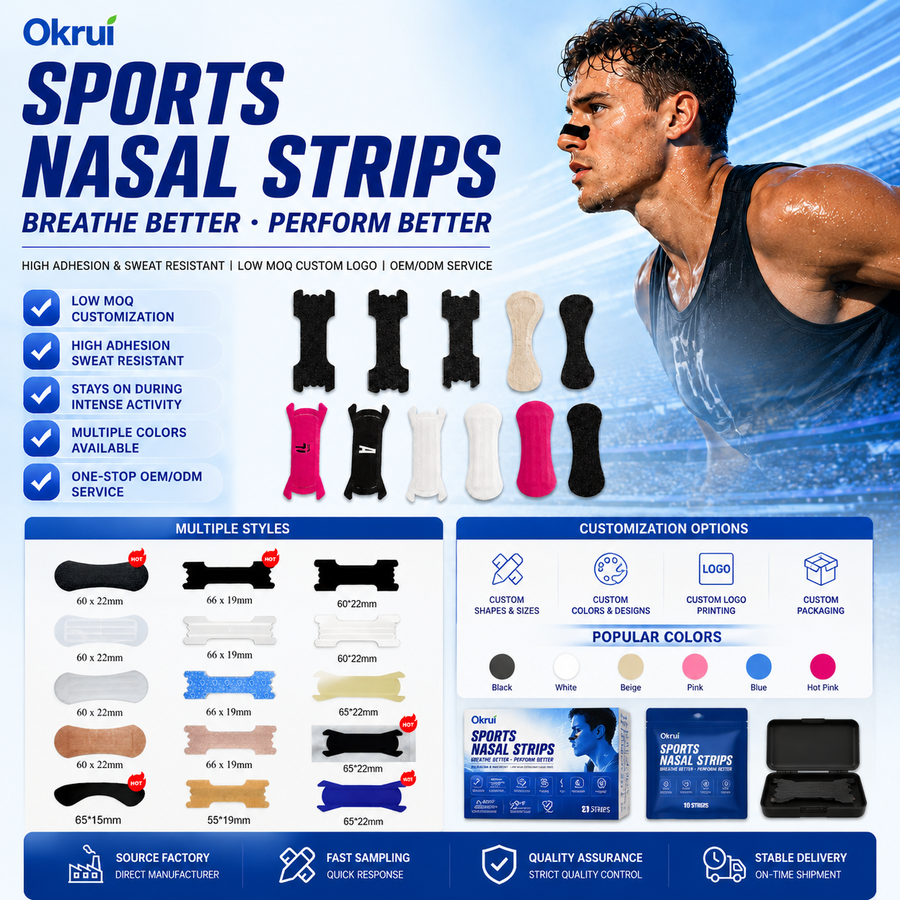
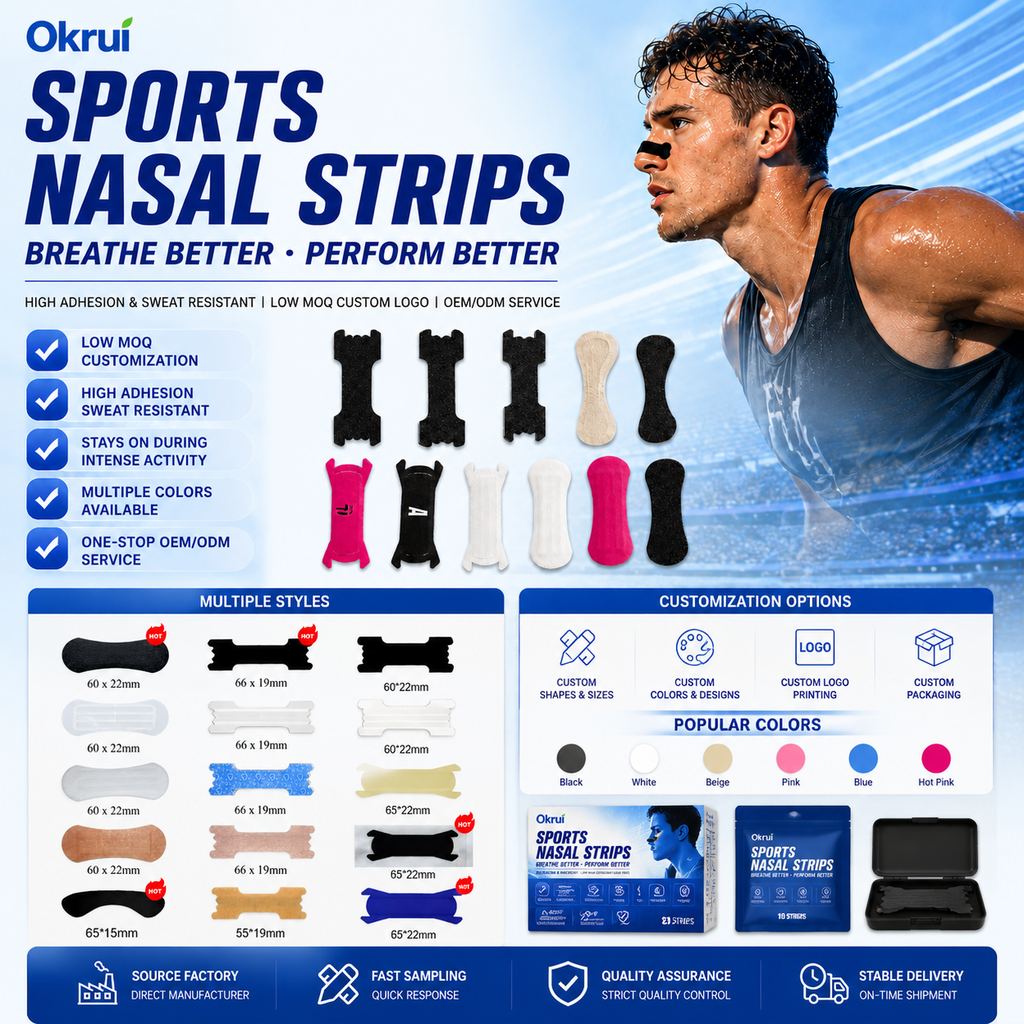
For runners, cyclists, fitness enthusiasts and other active consumers, breathing comfort can become an important part of the exercise experience. This has made sports nasal strips increasingly popular in the sports recovery, fitness and wellness markets.
From a manufacturer’s perspective, however, a sports nasal strip is more than a simple adhesive sticker. Its performance depends on the combination of mechanical structure, adhesive technology, backing material, strip elasticity, size, skin compatibility and manufacturing precision.
At Okrui, we manufacture health-care and beauty-care patches and work with brands on OEM and ODM product development. In this guide, we explain how sports nasal strips work, what materials are commonly used, what brands should consider when developing a custom product, and how to choose a suitable manufacturing partner.
What Are Sports Nasal Strips?
Sports nasal strips, also called external nasal dilator strips, are adhesive strips designed to be applied across the outside of the nose.
Unlike nasal sprays or medicated products, external nasal strips work through a mechanical principle. The strip applies an outward lifting force to the sides of the nose, helping support the nasal valve area during inhalation.
Research has shown that external nasal dilators can increase the cross-sectional area of the nasal valve and reduce nasal resistance in certain users.
For athletes and active consumers, this means that the main purpose of a nasal strip is generally to support nasal airflow and the subjective feeling of nasal openness, rather than directly increasing oxygen delivery or athletic performance.
This distinction is important when developing compliant product claims.
How Do Sports Nasal Strips Work?
A typical external nasal strip contains a flexible or spring-like structural component combined with an adhesive layer.
When the strip is applied correctly:
- The adhesive fixes the strip to the skin.
- The structural element creates gentle outward tension.
- The lateral nasal walls are supported.
- The nasal valve region may become more open.
- Airflow through the nasal passage can feel easier for some users.
The effect is primarily mechanical rather than pharmaceutical.
This is also why the design of the strip matters. A strip that is too soft may not provide enough lifting force, while a strip that is too rigid may feel uncomfortable or may not conform well to different nasal shapes.
Do Nasal Strips Improve Sports Performance?
This is one of the most important questions for sports brands.
The available research does not support a simple statement that nasal strips universally improve athletic performance.
A systematic review and meta-analysis examining external nasal dilator strips during exercise found no statistically significant improvement in VO₂max, heart rate or perceived exertion among healthy individuals. Other studies have reported improvements in nasal airflow or subjective nasal breathing under certain exercise conditions.
Therefore, the more technically responsible way to position a sports nasal strip is:
“Designed to support nasal airflow and breathing comfort during physical activity.”
Rather than:
“Guaranteed to improve athletic performance.”
For brands entering the sports wellness market, this difference is important for both scientific accuracy and marketing compliance.
What Materials Are Used in Sports Nasal Strips?
Material selection directly affects the user experience and product performance.
A typical sports nasal strip may include several functional components:
1. Backing Material
The backing layer provides the base structure of the product and can influence flexibility, appearance and skin comfort.
Common options include:
- Nonwoven fabric
- Polyester-based materials
- Flexible film
- Specialty breathable substrates
The appropriate material depends on the product positioning, skin-contact requirements and desired appearance.
2. Flexible Structural Element
The structural element is responsible for generating the mechanical lifting force.
Depending on the design, manufacturers may use a flexible polymer or spring-like strip.
Its key parameters include:
- Flexibility
- Recovery force
- Thickness
- Width
- Shape
- Fatigue resistance
For sports applications, the balance between lifting force and comfort is particularly important because the product may be exposed to sweat and prolonged movement.
3. Pressure-Sensitive Adhesive
Adhesive performance is one of the most critical parts of nasal strip manufacturing.
A sports nasal strip needs sufficient adhesion to remain attached during:
- Running
- Cycling
- Gym workouts
- Outdoor sports
- Sweating
- Extended wear
At the same time, excessive adhesion may increase discomfort during removal.
A professional manufacturer therefore needs to evaluate both:
Adhesion performance + removal comfort
rather than simply pursuing the strongest possible adhesive.
Why Adhesive Selection Matters for Sports Nasal Strips
Sports users have different requirements from ordinary cosmetic patch users.
During exercise, sweat, sebum, facial movement and environmental humidity can affect adhesion.
A suitable adhesive system should therefore be evaluated under realistic conditions.
At Okrui, product development can consider variables such as:
- Adhesive strength
- Initial tack
- Holding power
- Peel performance
- Sweat resistance
- Skin compatibility
- Removal characteristics
- Wearing duration
Different markets may also require different adhesive specifications.
For example, a product designed for short-duration fitness use may require a different adhesive balance from a product intended for overnight or extended wear.
Sports Nasal Strip Design: One Size Does Not Fit All
Nasal anatomy varies considerably between users.
For this reason, brands developing sports nasal strips should consider more than simply choosing a standard size.
Important design variables include:
- Overall strip length
- Strip width
- Curvature
- Structural element position
- Adhesive coverage
- Edge shape
- Center flexibility
- Lifting force
For mass-market products, brands may also consider developing different sizes such as:
Small / Medium / Large
or designing a flexible universal size.
For OEM projects, the final structure should ideally be confirmed through prototype testing rather than relying only on drawings.
Sports Nasal Strips for Different Activities
The same basic technology can be adapted for different sports markets.
Running Nasal Strips
Running products generally focus on lightweight construction, stable adhesion and comfortable breathing.
Cycling Nasal Strips
Cycling products may emphasize aerodynamic appearance, sweat resistance and long-duration adhesion.
Fitness & Gym Nasal Strips
For gym and functional training products, comfort, appearance and easy application can be important selling points.
Outdoor Sports
Outdoor applications may require additional consideration of temperature, humidity, sweat and long-duration wear.
This is why OEM development should begin with the intended application scenario rather than simply copying an existing nasal strip.
How Okrui Approaches Sports Nasal Strip OEM/ODM Manufacturing
As a health-care and beauty-care patch manufacturer, Okrui approaches sports nasal strip development from both the material and manufacturing perspective.
For an OEM or ODM project, we can work with brands on:
Product Structure
Developing the overall strip structure according to the desired mechanical performance and application experience.
Material Selection
Matching backing materials, structural components and adhesive systems according to the target market and product positioning.
Size & Shape
Supporting custom dimensions, different shapes and application-specific designs.
Adhesive Development
Adjusting adhesive performance according to target wearing time, skin characteristics and activity conditions.
Branding & Printing
Supporting private-label branding, logo printing, customized colors and visual design.
Packaging
OEM packaging options can include:
- Individual sachets
- Multi-piece bags
- Retail boxes
- Custom cartons
- Display-ready packaging
Prototype Development
Before mass production, prototype samples can be evaluated for:
- Adhesion
- Flexibility
- Comfort
- Appearance
- Structural performance
- Application and removal
- Wearing stability
This process helps brands identify potential issues before moving into large-scale production.
What Should Brands Check Before Choosing a Nasal Strip Manufacturer?
For brands sourcing sports nasal strips, price should not be the only consideration.
We recommend evaluating the manufacturer across several areas:
1. Material capability
Can the factory provide different backing and adhesive options?
2. Product development capability
Can the manufacturer modify the structure instead of only supplying an existing product?
3. Adhesive expertise
Can the factory balance strong adhesion with comfortable removal?
4. Manufacturing consistency
Can the factory maintain stable dimensions, adhesive coating and structural positioning during mass production?
5. OEM/ODM flexibility
Can the supplier support custom sizes, colors, logos and packaging?
6. Sample development
Can the factory provide prototypes before mass production?
7. Quality control
Does the manufacturer have defined inspection procedures for incoming materials, production and finished products?
These factors can have a much greater impact on the final product than a small difference in unit price.
Sports Nasal Strips Are More Than an Adhesive Product
From the outside, a nasal strip may look simple.
From a manufacturing perspective, however, it is a combination of:
Material Science + Mechanical Design + Adhesive Technology + Skin Contact + Manufacturing Precision
The final user experience depends on how these elements work together.
For sports brands, the objective should not simply be to create the strongest nasal strip. The goal is to develop a product with an appropriate balance of lifting force, adhesion, comfort, flexibility, appearance and application experience.
Looking for a Sports Nasal Strip OEM/ODM Manufacturer?
Okrui provides OEM/ODM manufacturing solutions for health-care and beauty-care patch products.
If you are developing a new sports nasal strip, athletic nasal strip, breathing strip or private-label nasal dilator, our team can work with you on product structure, materials, adhesive specifications, size, printing and packaging.
Whether you already have a finished design or only have a product concept, the development process can start from your target market, application scenario and performance requirements.
Contact Okrui to discuss your custom sports nasal strip project.
Frequently Asked Questions
Are sports nasal strips safe?
External nasal strips are non-invasive mechanical products. However, users should follow the manufacturer’s application instructions and discontinue use if significant skin irritation occurs.
Can nasal strips improve oxygen levels?
Nasal strips are designed to mechanically support the external nasal passage. They should not be presented as a guaranteed method for increasing blood oxygen levels.
Can I use nasal strips while running?
Sports nasal strips are commonly designed for physical activity. Product performance can depend on adhesive selection, skin condition, sweat and the specific design.
Can I customize the size and shape?
Yes. OEM manufacturers can develop different sizes, shapes, structural designs and packaging according to the brand’s requirements.
Can Okrui provide private-label nasal strips?
Yes. Okrui can support OEM/ODM development, including product structure, materials, adhesive specifications, logo printing and packaging.
What is the MOQ for custom sports nasal strips?
MOQ depends on the product structure, material selection, printing method and packaging requirements. Contact Okrui with your target specification for a project-specific quotation.